Why a Mug Handle Needs Room for a Grip
Mug handle grip clearance affects comfort, balance and control. Learn how shape, space and attachment suit different hands and holding habits.
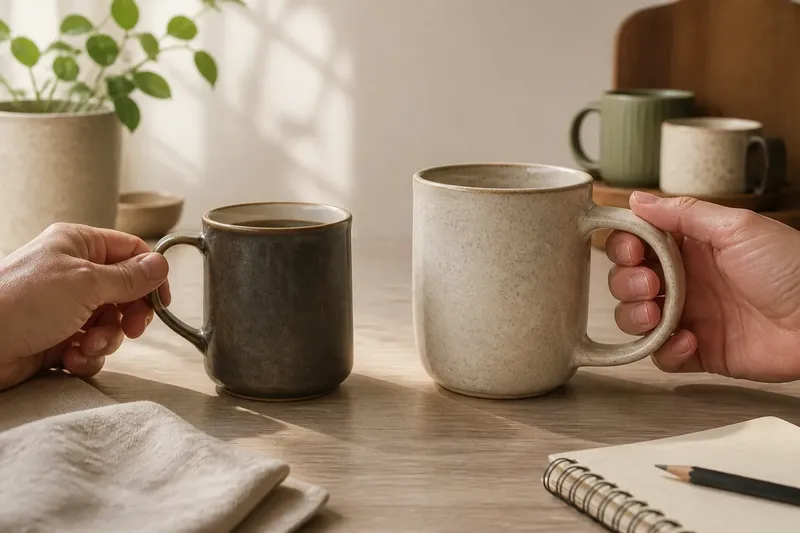
A mug handle needs enough room for the fingers that will use it, not merely a neat outline on a shelf. Mug handle grip clearance—the open space between the handle and the cup body—shapes how a person holds, lifts and sets down a mug. It is a design choice, not a test of whether someone is holding it correctly.
Hands differ, as do habits. One person may hook a finger through a narrow loop; another may wrap several fingers around a broad handle. The cup’s weight, the thickness of its rim and the way it is filled also influence the grip. Good design gives these factors room to work together.
Clearance changes the grip a handle invites
A handle can look generous from the side while offering little usable space once fingers enter it. The cup’s curved wall may occupy much of the opening, and a thick handle can reduce the gap further. What matters is the space available where the fingers actually rest, not the outer size of the loop.
Finger clearance affects both comfort and control. If the gap is tight, fingers may press against the cup wall or handle, concentrating contact in a small area. A more open gap can let the hand settle without squeezing, though an especially large loop may feel awkward to someone who prefers a close, secure hold.
There is no single ideal grip. Some people lift a light mug by its handle with one finger. Others use two or more fingers, or steady the cup with the other hand. Someone with limited finger movement may value an opening that is easy to enter and leave; a person who likes a compact hold may prefer a smaller loop. A useful handle accommodates its intended users without implying that one pattern is universal.
Shape guides where the hand rests
The handle’s cross-section—the shape seen if it were cut across its thickness—helps determine how pressure feels. A rounded, substantial section spreads contact across more of the hand than a thin edge. A flat section can offer a clear resting surface, while a sharply angular one may create pressure points during a firm lift.
The inside curve matters too. A smooth bend can make it easier to slide fingers into place. A tight turn may restrict movement, while a broad curve can leave the hand searching for a stable position. The right balance depends on the intended grip and the relationship between handle, cup wall and rim.
Handles also vary in their distance from the body of the mug. If the loop sits close, knuckles can brush the ceramic. If it projects far out, the mug may feel less compact in the hand and the handle may catch more easily during everyday use. Neither arrangement is automatically wrong; the question is whether the form supports a comfortable, controlled lift for the people likely to use it.
Attachment affects balance and trust
A handle is only useful if its junction with the cup suits the forces of lifting. The upper and lower attachment points transfer the load from the filled vessel to the hand. Their spacing, the amount of material around them and the shape of the transitions all contribute to how the connection feels.
A narrow neck where the handle joins the body can look delicate, but it may make the handle feel visually or physically less robust. A broad junction can appear dependable, yet it may intrude into the finger opening. Designers therefore balance support with clearance rather than treating either feature in isolation.
Attachment also changes how the mug responds to a tilted lift. If the grip sits high or far from the cup body, the hand may need to adjust its hold as the mug moves. A lower or closer connection can feel more integrated with the vessel, but its suitability depends on the cup’s overall shape and weight. For a filled mug, a secure-feeling grip is part of the design experience, not just a decorative detail.
How can you judge a handle before choosing a mug?
How many fingers should fit through a mug handle?
There is no required number. Try the grip you naturally use and check whether your fingers can enter and leave without rubbing hard against the cup or handle. If you often switch between one hand and two, consider whether the opening accommodates both habits.
Is a larger handle always more comfortable?
No. More space can help fingers move freely, but a very open loop may feel difficult to hold securely if your hand prefers close contact. Judge the opening alongside the handle’s thickness, curve and distance from the cup body.
What makes a mug handle feel stable?
A stable-feeling handle gives the hand a resting place that does not demand constant adjustment. The fit depends on the mug’s weight and balance as well as the grip, so consider the filled vessel rather than judging the handle as an isolated shape.
Can a handle be comfortable for different hands?
A handle can offer more than one plausible grip, but no shape will suit every hand and preference. A generous opening, smooth transitions and a clearly supported resting surface may help a wider range of users, while individual fit still matters.
Choose by handling the whole vessel
When possible, hold a mug before buying it. Put your fingers through the opening, let them rest naturally, and notice whether your knuckles meet the cup wall. Then lift the empty mug and imagine the added weight of its usual drink. Do not force a grip that feels cramped simply because the handle looks familiar.
Say you are choosing a mug for a shared kitchen where one person uses a single-finger hold and another prefers several fingers. Imagine comparing two mugs: one has a narrow loop with a thick edge; the other has a wider opening and a rounded section. If the second lets both people settle their hands without pressing into the cup wall, it may be the more flexible choice for that household. The result to look for is an easy, controlled lift for each person, not identical hand positions.
For online shopping, look for a side view that shows the opening clearly, along with views of the handle’s thickness and attachment points. Product photographs can conceal depth, so a description of dimensions may help, but it cannot tell you how the shape will feel in your hand. If possible, compare it with a mug you already use comfortably.
Material and care can alter the experience
Ceramic handles may feel cool and smooth, while textured stoneware can give the fingers a less slippery surface. A glazed handle can be easy to wipe clean; an unglazed area may feel different to the touch and can call for care suited to that finish. These qualities affect sensation, but they do not replace adequate clearance or a sound attachment.
Heat is another part of use. A handle’s separation from the cup body can influence how much warmth reaches the hand, though the mug’s material, wall thickness and contents matter too. Avoid assuming that any handle stays cool under every condition. Follow the maker’s care and use guidance, particularly where a mug is intended for a microwave or dishwasher.
Inspect the handle and its junctions during ordinary washing. A new crack, rough edge or movement at an attachment point can change the way the mug should be handled. If a defect appears, set the mug aside until you can judge whether it is safe to use; a professional repairer can advise on a repair suitable for that material and use.
A good grip leaves room for personal choice
Mug handle grip clearance is most useful when considered with shape, attachment, balance and the person holding the cup. A larger opening is not automatically better, and a familiar grip is not the only valid one. Look for a handle that lets the intended user place the hand naturally, lift with control and release without a struggle.
That final release deserves attention: a handle should not only let fingers enter, but also let them come away easily when the mug is set down. When comparing designs, notice both movements. A shape that supports a comfortable lift and an unhurried release is more likely to fit the rhythms of everyday use.