How Reusable Food Wrap Evolved from Waxed Cloth
Reusable food wrap history traces a shift from household cloths and improvised covers to purpose-made waxed wraps, helping you understand their distinct roles.
Reusable food wrap history is a story of household materials adapted for a particular job: covering food without always reaching for a container. Cloths, plates and lids served that purpose long before purpose-made waxed wraps appeared, and each remains useful for different reasons.
Household coverings began as ordinary objects
Before reusable wraps were sold as a distinct kitchen product, a covering could be a plate placed over a bowl, a lid that fitted a pot or a clean cloth laid over dough. These were practical uses for objects already in the home, rather than members of a single, standardised product category.
The covering did not necessarily seal food. A plate could shield a bowl from dust or contact with other items, while a cloth over dough kept the surface covered during preparation. The material and shape followed the task, and cleaning fitted into existing routines: plates went with dishes, and cloths with laundry.
Waxed cloth brought coating and fabric together
Waxed cloth combines a textile’s flexibility with a coating that changes how its surface handles moisture and folds. That pairing made it possible to wrap some solid foods or cover a dish with a material that could be put away for another use. It occupied a different design space from a loose tea towel or a rigid lid.
There is no single waxed-cloth recipe that defines every product or household version. Fabric, coating and intended use vary, so the name alone does not tell you whether a particular covering suits a specific food or cleaning routine. The product’s care and food-contact guidance should settle those questions.
Unlike an ordinary cloth, a coated wrap may need to stay away from heat or rough washing. Its useful feature is also a care constraint: a coating can be altered by conditions that a plain textile might tolerate. The design therefore depends on users treating it as a distinct material, not just as another tea towel.
Purpose-made wraps made the flexible format visible
Modern reusable wraps brought the flexible covering into a recognisable, purpose-made form. They are commonly cloth-based, with coatings intended to help a sheet hold a fold or sit around food. Products differ in composition and care instructions, so “reusable wrap” describes a format rather than one universal material.
That format addresses a specific design problem: a fixed lid only fits a compatible opening, while a flexible sheet can be shaped around some uneven items. In exchange, the user has to clean, dry and store it appropriately. A wrap that is awkward to care for may be less useful in practice than an ordinary plate or container already in the kitchen.
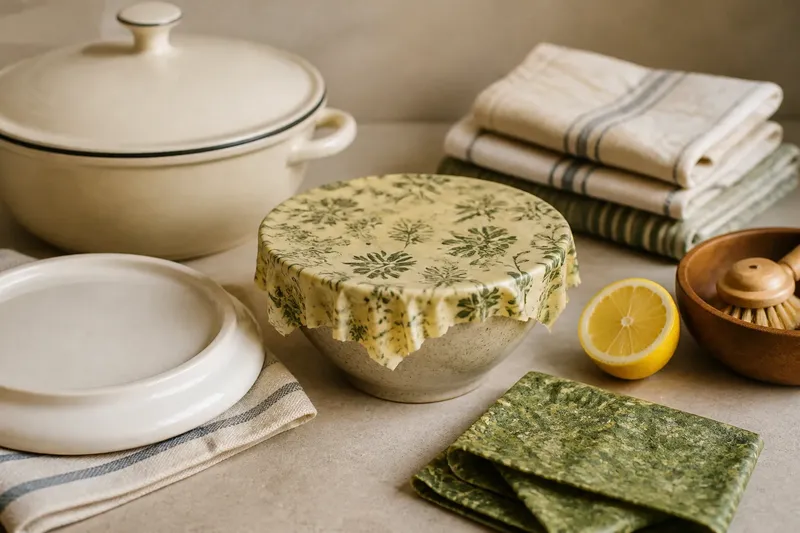
Say a household has a cut lemon, a clean small bowl and a waxed wrap whose maker says it is suitable for covering food. The household checks that the wrap is clean and dry, then presses it over the bowl rather than cutting a new cover. The visible result is a covered bowl, but the choice still depends on the product’s instructions and the household’s storage needs.
Reusable food wrap history explains why coverings remain varied
The history is not a simple progression in which each new covering makes the previous one obsolete. Household coverings differ in how they are shaped, cleaned and stored; those differences explain why several forms can coexist. A plate, a washable cloth, a fitted lid and a coated wrap each carry a different design logic.
- Observation: A clean plate sits securely over the bowl. If it covers the food without shifting, then use it for that task; otherwise, choose a better-fitting lid or container.
- Observation: A container has a matching lid that closes as intended. If the food and storage conditions suit that container, then use the lid; otherwise, select a covering specified for those conditions.
- Observation: The item has an uneven shape and the wrap’s instructions allow that use. If the wrap can sit securely, then use it; otherwise, place the food in a suitable container.
- Observation: A covering is still damp after cleaning. If it is not fully dry, then leave it out to dry; otherwise, put it away in a clean, dry place.
- Observation: The maker’s care information excludes heat or a particular washing method. If that condition applies, then avoid it; otherwise, follow the stated care directions.
- Observation: The surface is cracked, persistently stained or difficult to clean. If it no longer seems suitable for food contact, then stop using it for food; otherwise, continue only in line with its care guidance.
How do reusable food coverings fit different routines?
Is waxed cloth the same as a modern reusable wrap?
Both use a flexible, coated textile format, but the materials and intended uses can differ between products. Check the specific maker’s description rather than assuming that all waxed cloths have the same composition or care needs.
Can a reusable wrap replace a container lid?
Not in every situation. A wrap may suit some foods and shapes, while a compatible lid or container may be more appropriate when a firmer closure or particular storage condition is needed.
How should a coated food wrap be cleaned?
Follow its care instructions, since coatings may not tolerate the washing methods used for ordinary kitchen cloths. Let it dry fully before storing it, and avoid heat if the maker advises against it.
When should a food wrap stop being used?
Stop using it for food if it is damaged or cannot be cleaned as directed. If its suitability is unclear, consult the maker’s guidance and choose another covering in the meantime.
Care and storage shape a wrap’s usefulness
Plain cotton and coated cloth do not necessarily need the same care. A coated wrap may call for gentle cleaning and air-drying, while the instructions for a plain cloth may allow ordinary textile care. Follow the guidance for the actual product, especially when its composition or food-contact suitability is uncertain.
Once clean, leave a covering to dry fully before folding it away. A clean drawer, shelf or hook can work if the wrap stays dry and protected from contamination. If its surface is damaged or persistently difficult to clean, stop using it for food unless the maker’s guidance clearly supports continued use.
Reusable food wrap history offers a useful design lesson: a covering is shaped not only by its material, but by the work of cleaning and storing it. Choose the form that suits the food and the routine around it; a simple plate or fitted lid may be the better choice when a coated wrap’s care demands do not fit the household.