The More Compartments, the Better Myth
Learn how to judge storage compartments against your belongings and routine, so a drawer or organiser makes sorting easier instead of adding work.
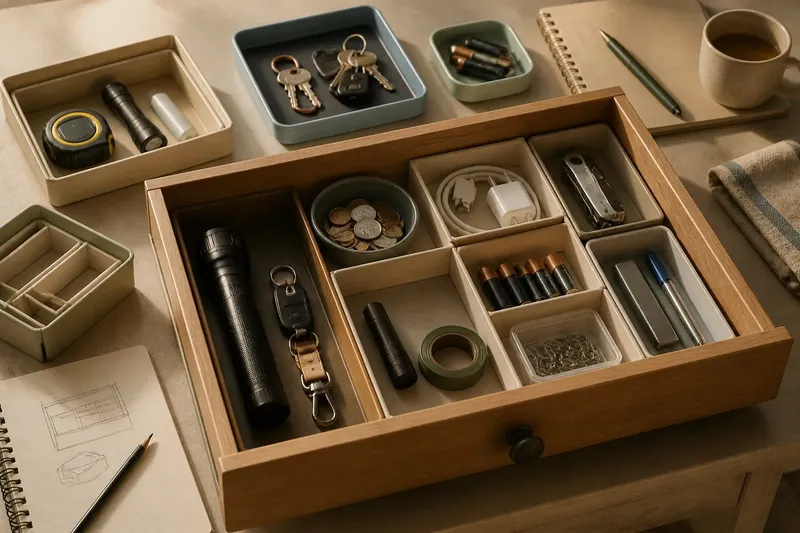
More compartments do not automatically make storage easier. A desk organiser with a slot for every pen, cable and paper clip can turn a quick tidy into a small sorting task; a few well-sized sections may serve the same belongings with less fuss. To judge storage compartments, start with what you keep and how you reach for it, then decide whether each division earns its place.
Start with the things that need a home
Choose one contained area, such as a kitchen drawer, bedside table or sewing box. Take out its contents and group together items that are used for the same purpose. Keep the groups practical rather than overly precise: charging leads can sit together, for example, instead of being separated by connector type if you reach for them interchangeably.
Notice which objects have a clear role and which are there because they accumulated. A storage design cannot make an unused item useful. Set aside anything that belongs elsewhere, is damaged or no longer serves your routine. This keeps the later decision about compartments focused on the objects you actually intend to store.
Now look at the shape of each group. A bundle of loose drawing pencils behaves differently from a stack of folded cloths. Consider whether items are long, flat, bulky, soft or likely to tangle. Their physical behaviour matters more than the number of categories you can name.
Watch how the contents move through a routine
Before choosing a layout, trace the ordinary sequence in which you use the items. Ask what you take out together, what returns together and what must be visible at a glance. A compartment is useful when it supports one of those actions, not merely because it gives another object a designated spot.
For example, a sewing kit might be used to mend a button: thread, needle and scissors are gathered at once, while spare buttons are consulted less often. That routine may call for a shared working area for the frequently paired tools and a separate place for small loose pieces. A partition between every colour of thread could add distinctions without helping the task.
Pay attention to interruptions as well. If you often put something down before finishing a task, a broad, forgiving space can be easier to use than a narrow slot that demands careful placement. If small objects repeatedly disappear beneath larger ones, a shallower section or a tray that lifts out may help. These observations reveal the real problem a divider should solve.
Match each division to a useful distinction
Before adding a partition, state what it separates and why that separation matters. Useful distinctions often concern function, access or containment:
- Different tasks: keep first-aid supplies apart from grooming items in a bathroom drawer.
- Different access patterns: give frequently used scissors an open, reachable place rather than burying them with occasional tools.
- Loose pieces: contain small fasteners so they do not scatter among larger objects.
- Fragile or awkward shapes: prevent delicate items from rubbing against heavier ones.
- Shared routines: keep items used together close enough to retrieve as a group.
A distinction can be real without needing its own compartment. Two types of object may be easy to recognise in one open bin, especially if they are different in shape or have their own cases. Conversely, items that look alike but serve unrelated tasks may be easier to retrieve when separated. The question is not whether a category exists; it is whether physical separation makes use clearer.
Choose a layout that fits the objects
Once you know what needs to stay together or apart, compare the storage form with the contents. Fixed compartments provide a stable arrangement, but their dimensions may not suit objects that vary in size. Adjustable dividers let you alter the layout, though they still take up space and can shift if the organiser is poorly suited to the drawer.
Open trays work well for objects that need to be visible and lifted out easily. A lidded box can contain small pieces or keep dust away, but it adds a step when you need access. Deep sections can hold bulky objects, yet small items at the bottom may be hard to see. Think about how much of the contents should be visible, and whether the container itself is easy to remove and clean.
Materials shape the experience too. A wooden divider may feel solid in a desk drawer, while a washable plastic tray may suit a space where dust or spills are likely. Fabric pockets can accommodate soft items but may sag when loaded. Choose based on the objects, the setting and the care the material needs, rather than assuming a more elaborate organiser is inherently more useful.
Try a reversible arrangement before settling on it
Use temporary containers to see whether the proposed groups make sense in the space. Small cardboard boxes, shallow dishes or spare trays can suggest the footprint of a compartment without committing you to a fitted insert. Keep the arrangement simple enough that you can change it after using the drawer or box in its normal routine.
Imagine you are organising a hall drawer that holds keys, a torch, spare batteries, a tape measure and loose coins. You might begin with a small dish for coins, a reachable area for keys and the torch, and one shared section for the less frequently used items. After a week of ordinary use, you may notice that the tape measure is always borrowed with the torch; moving them together could make the drawer work more naturally. This is an invented scenario, but the decision process is practical: observe retrieval, then adjust the layout to match it.
Do not fill every temporary space simply because it is available. Leave room for objects that arrive through the routine, and check that the contents can be put away without rearranging their neighbours. A storage arrangement should tolerate ordinary variation; it should not require each item to land in exactly the same position every time.
How can you tell whether a compartment is useful?
Should every type of item have its own section?
No. Give a type its own section when separation makes it easier to find, protect or return. If two kinds of item are easy to distinguish and commonly used together, a shared area may be simpler.
Are fixed or adjustable dividers better?
Fixed dividers suit contents whose shapes and groupings stay fairly stable. Adjustable dividers can accommodate changing belongings, but the mechanism should remain secure and easy to alter.
What should you do when a compartment stays empty?
Check whether the object it was meant for belongs in that storage area and whether the section is accessible. If the routine does not use it, remove or repurpose the divider rather than preserving an unused category.
How do you organise objects with changing sizes?
Use a flexible container or an open section that can accept variation without blocking access. Keep a boundary only if it prevents a specific problem, such as small pieces spreading through the rest of the space.
Keep the arrangement easy to revise
Storage needs can change when a household routine shifts, a tool is replaced or a hobby takes up more space. Prefer arrangements that can be altered without discarding a whole organiser. A removable tray, a plain box or a repositionable divider can give you options if the contents change.
When buying a purpose-made organiser, check its materials, cleaning guidance and compatibility with the place where it will sit. If a product’s care or fitting depends on its label, manufacturer instructions or local requirements, follow those rather than guessing. For an everyday drawer, also consider whether the insert can be lifted out for cleaning and whether its edges leave room for the drawer to open and close normally.
Finally, review the contents after you have used the arrangement in your usual routine. If you repeatedly move an item between sections, that may be evidence that the category is unhelpful or the division is in the wrong place. The best storage compartments are not the ones that impose the neatest map; they are the ones that make returning and retrieving belongings feel straightforward.